Pinotage is South Africa’s own wine grape — the only internationally grown variety ever bred here. Created in 1925 at Stellenbosch University by crossing Pinot Noir with Cinsault, it produces a bold, smoky, dark-fruited red found almost nowhere else on earth. If you’ve only had one bad glass, modern Pinotage deserves a second look.
Jump to: Origin story · What it tastes like · Where it grows · Food pairing · Best producers · Where to buy · FAQs
Every bottle of Pinotage you drink — whether from a bush vine in Swartland or a new-wave producer in Elgin — traces back to that single 1925 experiment, and no other country has adopted it as a signature grape. It has been polarising wine drinkers for a century, but the last ten years of South African winemaking are worth a second look: modern Pinotage is not what your uncle used to drink. This guide covers what Pinotage actually is, how it tastes, where it grows, and — if you want to try the best of it without the cellar-door markup — where to buy it.
The Origin Story: A Stellenbosch Experiment in 1925
Abraham Izak Perold, the first Professor of Viticulture at Stellenbosch University, crossed Pinot Noir with Cinsault (then known locally as Hermitage) in 1925. His goal was to combine Pinot Noir’s complexity with Cinsault’s hardiness — a Pinot that could survive the Cape’s summer heat.
Perold planted the four resulting seedlings in the garden of his university-owned cottage in Welgevallen. Then, in 1927, he left Stellenbosch for a new job at KWV. The cottage was reassigned. The seedlings were nearly mulched during a routine clean-up — only saved because a young lecturer, Charlie Niehaus, happened to cycle past and recognised what they were. He rescued them, and the line survived.
The first commercial Pinotage wasn’t bottled until 1959, when Lanzerac Estate released it. Within a decade, it had won major South African wine awards, and by the 1970s, it had become one of the most planted red varietals in the country.
Today, Pinotage covers roughly 7 000 hectares of South African vineyard — about 6% of national plantings — and it is the country’s most distinctive contribution to world wine.
What Does Pinotage Taste Like?
Pinotage tastes bold and smoky: dark berry fruit — blackberry, plum, mulberry — layered with smoke, earth and spice. Medium to full body, moderate tannins, 13.5–14.5% alcohol. Well-made Pinotage carries the fruit-weight of a Shiraz with the structure of a Pinot Noir.
Two things give Pinotage its divisive reputation. First, warmer-climate Pinotage can develop a banana or rubber note — usually a sign of overripe fruit or a heavy hand during fermentation. The better producers have largely eliminated this over the past fifteen years. Second, the “coffee Pinotage” style — pioneered by Diemersfontein in the early 2000s and imitated widely — uses heavy American oak toast to produce aromas of roasted coffee and dark chocolate. Commercially successful, stylistically controversial.
Modern Pinotage — the style you’ll find from producers like Kanonkop, Beyerskloof, and most new-wave Swartland winemakers — dials back the oak and lets the fruit and terroir do the talking. Food-friendly, age-worthy, unmistakably South African.
How Pinotage Is Made
Pinotage is not a forgiving grape. Harvest timing is everything — pick too late and you get alcohol, jam, and rubber; pick too early and it tastes green and hollow. South African winemakers have spent decades learning to catch the window.
Modern Pinotage winemaking typically involves a short cold soak (24–48 hours) to extract colour and primary fruit character, followed by temperature-controlled fermentation to preserve freshness. The juice spends 12 to 18 months in oak — the trend has shifted from heavy American oak toward lighter French oak, or a 50/50 blend, to tame the grape’s natural exuberance without masking its identity.
Old-vine Pinotage — bush vines over 35 years old — is a small but growing category. These vineyards, many of them in Swartland and Stellenbosch, produce lower yields, thicker skins, and more concentrated fruit. The wines are serious, age-worthy, and increasingly sought after by collectors.
Where Pinotage Grows in South Africa
Stellenbosch remains the historical heartland. Warmer subregions like Bottelary and Simonsberg give riper, fuller-bodied wines. This is where you’ll find the most-decorated Pinotage producers — Kanonkop, Beyerskloof, Lanzerac.
Swartland produces a different Pinotage — cooler ocean winds, older bush vines, and a newer generation of winemakers have shifted the style towards the savoury, earthy, and structured. This is Pinotage for people who think they don’t like Pinotage.
Paarl gives fuller-bodied, higher-alcohol examples — classic braai wine territory.
Worcester and the Breedekloof Valley — including the Stettyn Valley — produce Pinotage at excellent value. Warmer climate, generous fruit, and producers who’ve been quietly making high-quality wine without the Stellenbosch price premium.
Cooler regions — Elgin, Walker Bay, Hemel-en-Aarde — are a newer frontier for Pinotage. Lower alcohol, brighter acidity, and a lighter, more Burgundian expression. If you’ve only tried the bold Stellenbosch style, these are worth seeking out.
Food Pairing: What to Eat With Pinotage
Pinotage was made for South African food, and this is not an exaggeration. The grape’s smoky, savoury, fruit-forward profile is engineered — accidentally — for the braai.
- Braai meats: boerewors, lamb chops, sirloin steak, and anything charred. The smoke in the wine and the smoke on the meat do a duet.
- Game: kudu, springbok, gemsbok, venison. Pinotage’s earthiness handles the gaminess better than almost any other red.
- Bobotie and curry: the wine’s fruit sweetness balances the spice; the structure holds up to the complexity.
- BBQ and smoked meats: pulled pork, brisket, smoked beef ribs. American BBQ style works surprisingly well with coffee-style Pinotage.
- Dark chocolate desserts: Pinotage and 70% cocoa is a genuine match — the bitter chocolate picks up the smoky spice notes.
- Vegetarian: mushroom risotto, roasted aubergine, smoked paprika dishes. Pinotage is more vegetarian-friendly than most bold reds.
What to avoid: delicate white fish, fresh salads, and light pastas. Pinotage will flatten them.
Pinotage vs Shiraz: How to Choose
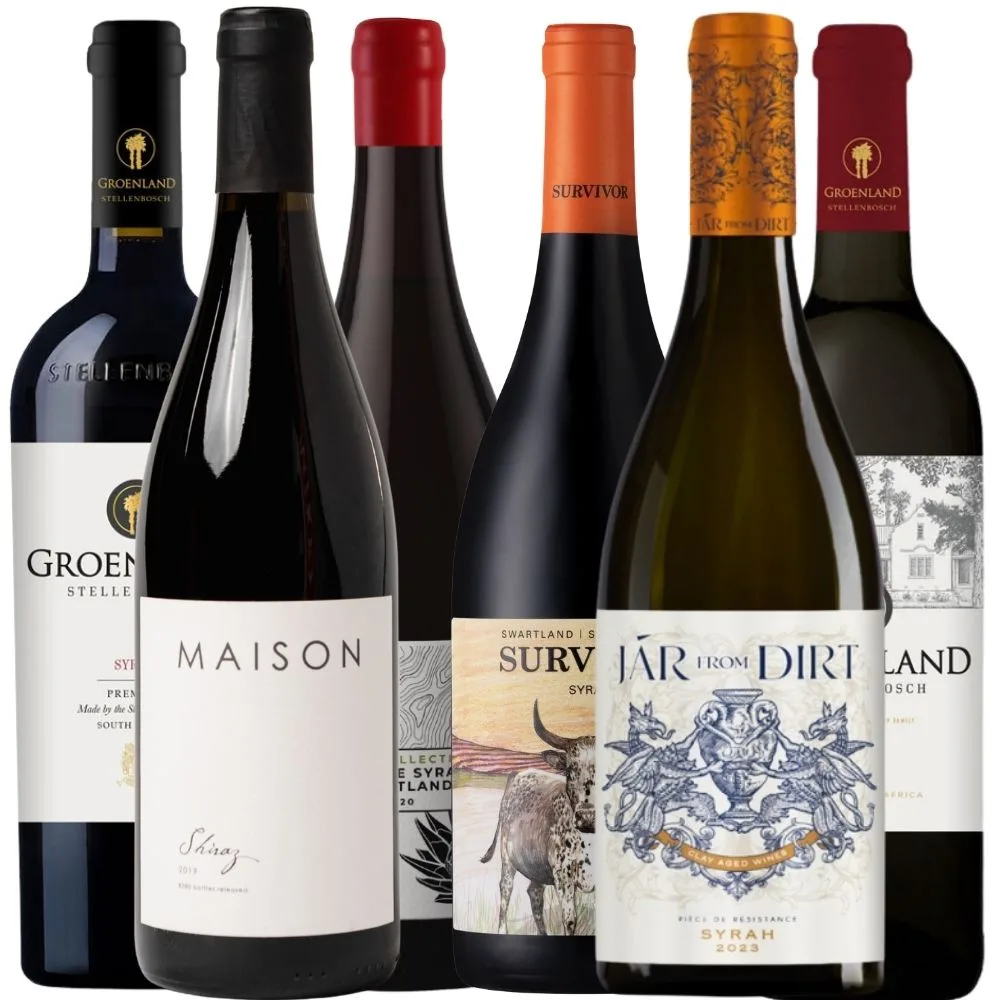
South African Shiraz and Pinotage both deliver bold, full-bodied reds — but they lean in different directions. Shiraz is peppery, richer, and more internationally familiar. Pinotage is smokier, earthier, and unambiguously South African.
If you’re matching wine to occasion: Shiraz is a safer choice when you’re feeding wine-sceptics or sending a gift. Pinotage is the better call when you’re braaiing, when the food has game or spice, or when you want to drink something that couldn’t have come from anywhere else.
For a fuller breakdown, see our South African Shiraz guide.
The Best Pinotage Producers in South Africa
Kanonkop (Stellenbosch) — The benchmark. Four-times-winner of the Diners Club Winemaker of the Year for Pinotage. The flagship Paul Sauer is a Cape Blend, but the straight Pinotage is consistently one of South Africa’s top-rated wines.
Beyerskloof (Stellenbosch) — South Africa’s Pinotage specialist. Beyers Truter bottled the first modern Pinotage that won international critical praise. Their range runs from entry-level to cellar-worthy.
Lanzerac (Stellenbosch) — The original commercial Pinotage producer (1959). Historical significance aside, the current wines are well-made and excellent value.
Simonsig (Stellenbosch) — Long-time Pinotage producer, known for consistent quality across vintages.
Diemersfontein (Wellington) — The original “coffee Pinotage” — heavy oak, roasted coffee and chocolate aromas. Polarising, but undeniably popular.
Spier, Fairview, Stettyn — Strong value-end producers making honest, well-balanced Pinotage at accessible prices.
Where to Buy Pinotage Online in South Africa
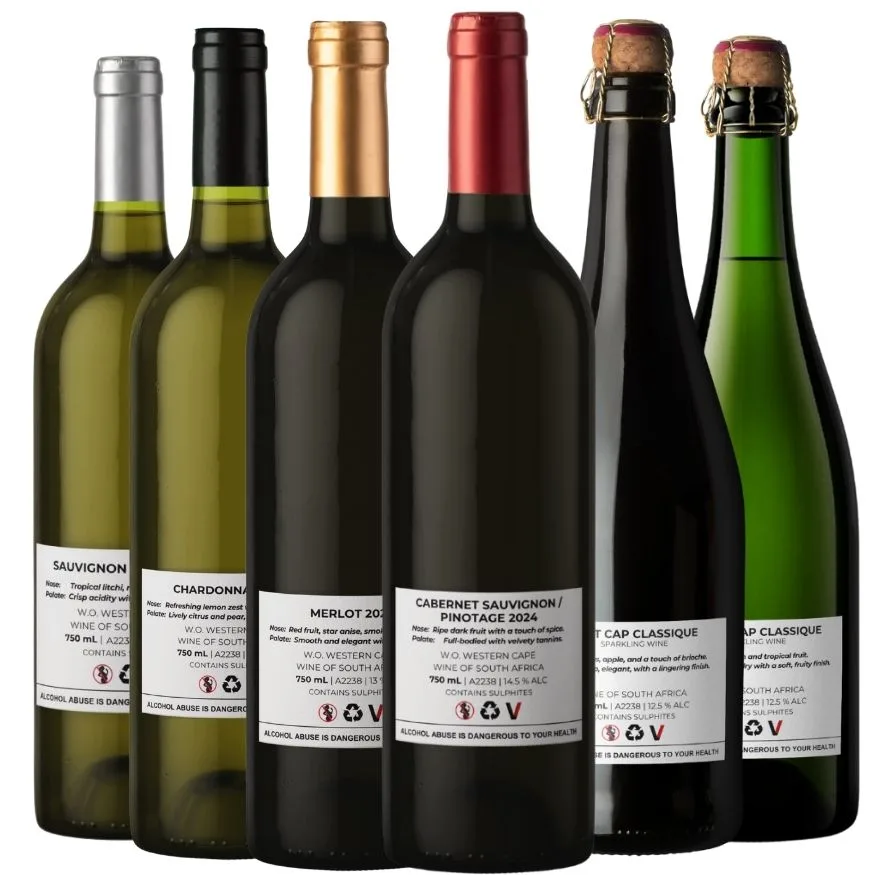
Vinty is South Africa’s unlabelled wine retailer — we source surplus Pinotage directly from established producers and sell it by the case, without the label tax. A Pinotage that retails for R220 at a Stellenbosch cellar door often sells for under R130 at Vinty, unlabelled but identical. Same fruit, same winemaker, same vintage.
Browse Vinty’s current Pinotage selection:
In stock now:
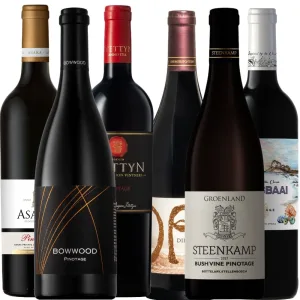
- Vondeling Bowwood Pinotage 2022 — flagship single-block Pinotage, Tim Atkin 92 & Platter’s 4.5★ — R 2 382/case (R 397/bottle)
- Diemersfontein Coffee Pinotage 2024 — the original “coffee Pinotage” — R 882/case (R 147/bottle)
- False Bay Bush Vine Pinotage 2023 — wild-yeast old-vine value pick, Decanter 93 — R 498/case (R 83/bottle)
Explore more at our XCellar range, view the full South African red wine guide, or see how Pinotage fits into our full guide to South African wine types.
Frequently Asked Questions About Pinotage
Is Pinotage the same as Pinot Noir?
No. Pinotage is a South African grape variety created in 1925 by crossing Pinot Noir with Cinsault. It shares a parent with Pinot Noir but is a genuinely different grape — darker, bolder, smokier, and only grown commercially in South Africa.
What does Pinotage taste like?
Dark berry fruits — blackberry, plum, mulberry — with layers of smoke, earth, spice, and sometimes dark chocolate or coffee. Medium to full body, moderate tannins, food-friendly acidity. Modern Pinotage is balanced and savoury; older or cheaper examples can show a banana or rubber note that is not representative of the grape at its best.
Is Pinotage a good wine?
Yes — when well-made, Pinotage is one of the most distinctive and age-worthy red wines in the world. Producers like Kanonkop and Beyerskloof have been winning international awards for decades. Like any grape, quality varies by producer — but a good Pinotage is genuinely world-class.
How long can you age Pinotage?
Premium Pinotage from top producers ages beautifully for 10 to 20 years. Entry-level Pinotage is built for drinking young — within 3 to 5 years of vintage. Old-vine Pinotage from Stellenbosch and Swartland can develop extraordinary complexity with a decade or more of cellaring.
What is the best Pinotage in South Africa?
Kanonkop Black Label Pinotage and Beyerskloof Diesel are consistently rated South Africa’s top Pinotage wines. For value, look at Stettyn, Spier, and Fairview. For the new-wave Swartland style, seek out producers like David & Nadia and Mullineux.
Is Pinotage only grown in South Africa?
Commercially, yes. A handful of vineyards exist in the United States, New Zealand, Brazil, and Zimbabwe, but South Africa produces over 95% of the world’s Pinotage. It is the only grape variety that is uniquely and definitively South African.
What is the difference between Pinotage and Cape Blend?
Pinotage is a single grape variety. Cape Blend is a South African red blend that, by convention, contains at least 30% Pinotage alongside other red varieties (usually Cabernet Sauvignon, Merlot, and Shiraz). The Cape Blend concept was created to showcase Pinotage as a blending partner — Kanonkop’s Paul Sauer is the benchmark example.