How to Build a Wine Cellar in South Africa: The 2026 Guide
Building a wine cellar at home sounds like a dream for many South Africans, but it goes far beyond stacking bottles in a cool corner. You might think any spare cupboard will do, but the truth is that temperature swings as small as 2°C can destroy the ageing potential of your favourite vintage.
Most people miss this simple fact and end up spoiling their collection long before the big occasion. This guide covers everything you need to plan, build, and stock a proper South African wine cellar — from the right space and materials through to climate control and, critically, the wines actually worth putting in it.
Planning Your Home Wine Cellar: Location and Space
Creating a wine cellar in South Africa is about preserving your collection through our highly variable climate. Underground stone rooms are the ideal, but South African homes offer plenty of practical alternatives — and with the right setup, any dedicated space can perform.
Choosing the Right Location
Your ideal space needs consistent temperature and humidity control. Avoid areas with direct sunlight, significant temperature fluctuations, or proximity to vibration sources like washing machines or entertainment systems. Key factors:
- Temperature stability: Aim for 12–16°C consistently
- Humidity: Maintain 50–80% — too dry and corks shrink, too wet and mould sets in
- Light: UV radiation degrades wine faster than almost anything else
- Vibration: Constant movement disturbs sediment and disrupts ageing
South African basement areas work wonderfully for temperature stability, but they’re not common in our architecture. Dedicated closets, converted pantries, and under-stair spaces are far more typical — and with proper insulation and climate control, they perform well.
Spatial Configuration Options
When evaluating potential spaces, measure precisely. Allow room not just for bottles, but for proper air circulation, cooling equipment, and room to grow your collection.
| Location | Thermal Stability | Ease of Insulation | Light Protection | Expansion Room |
|---|---|---|---|---|
| Under-stair storage | High | Moderate | High | Limited |
| Converted pantry | Moderate | High | Moderate | Moderate |
| Dedicated closet | Moderate | High | High | Moderate |
| Basement area | High | High | High | High |
Climate Control for a South African Wine Cellar
South Africa’s climate demands more than a ‘cool corner’. In Cape Town and Stellenbosch, summer temperatures regularly exceed 35°C. In Johannesburg, the swing between a July night and a January afternoon can be 30+ degrees. A wine collection left unprotected in these conditions won’t last.
The good news: dedicated wine cooling units have come down significantly in price. The threshold for investment is much lower than it was a decade ago, and the cost of spoiling a carefully curated collection is always higher.
What to Look For in a Wine Cooling Unit
- Dual-zone temperature controls — lets you store reds and whites at different temperatures
- Vibration-free compressor systems — standard compressors vibrate and disturb sediment
- UV-protected glass doors — essential if the unit is in a room with natural light
- Adjustable shelving — different bottle formats need different rack heights
- Humidity management — look for units that actively monitor and adjust, not just cool
For larger purpose-built cellars, a dedicated split cooling system (similar to reverse-cycle aircon but calibrated for wine storage conditions) is the professional standard. Pair it with digital temperature and humidity monitors and a backup power solution for load-shedding resilience.
Choosing the Right Materials
The materials you build with determine how well your cellar holds temperature and manages humidity. Getting this right saves energy costs and protects your collection long-term.
Recommended Building Materials
- Redwood: Natural moisture resistance and thermal stability — the traditional choice for wine racking
- Concrete: Excellent thermal mass; a concrete room takes longer to heat and cool, which buffers against temperature swings
- Specialised wine cellar panels: Pre-engineered for precise temperature control with built-in insulation
- UV-protective glass: Essential for display walls — blocks radiation while showing off your collection
Insulation is non-negotiable. Use materials with high R-values to prevent external temperature infiltration. Vapour barriers are equally important — SA’s humidity variation is significant, particularly in coastal areas like Cape Town.
A Note on Professional Help
If you’re converting a space rather than building from scratch, consult a local wine storage specialist. They understand the specific climatic challenges of your region — a Cape Town build faces different conditions to a Johannesburg or Durban one. The cost of getting it right the first time is almost always less than fixing a humidity problem six months later.
Cellaring Tips for South African Wines
Not all South African wines reward cellaring. Understanding which bottles to lay down — and which to enjoy young — is the difference between a purposeful collection and wasted shelf space.
Which SA Wines Age Well?
South Africa’s wine regions produce dramatically different ageing profiles. Cooler regions like Elgin, Constantia, and Walker Bay tend to produce wines with better natural acidity and more complex ageing trajectories. Stellenbosch reds, particularly structured Cabernets and Syrahs, are perennial cellar candidates.
| Factor | Impact on Ageing | SA Examples |
|---|---|---|
| Grape variety | High tannin reds age best | Cab Sauvignon, Syrah, Pinotage |
| Tannin structure | Firm tannins = longer window | Stellenbosch Cab, Swartland Shiraz |
| Acidity | Balanced acidity = freshness over time | Elgin Pinot, Constantia Sauv Blanc |
| Winemaking | Minimal intervention ages more gracefully | Boutique/estate producers |
| Region | Cooler = longer, more complex trajectory | Elgin, Constantia, Walker Bay |
Optimal Storage Conditions
- Temperature: 12–14°C for long-term ageing
- Humidity: 60–70% — enough to keep corks moist, not enough to cause mould
- Position: Horizontal storage keeps the cork in contact with the wine
- Light: Zero UV exposure; even incandescent light degrades wine over time
- Vibration: Avoid shelving near appliances, traffic, or air conditioning units
Keep a cellar log. Record purchase date, producer, vintage, and any tasting notes. Track how each wine evolves. This turns your cellar from a storage solution into a genuine collection — and helps you decide when bottles are at their peak.
What to Put In Your Cellar: Filling It Smartly
Here’s the part most cellar guides skip: the wine itself. You can build the most technically perfect cellar in Stellenbosch, but if it’s filled with mediocre bottles, you’ve wasted the investment.
The economics of a wine cellar favour value-focused buying. When you’re thinking in dozens of bottles rather than one at a time, the price-per-bottle gap between a branded estate wine and a quality unlabelled equivalent is not a rounding error — it’s the difference between filling a 48-bottle cellar for R 4 800 or R 18 000. Same juice. Very different label.
The XCellar Range: Cellar-Worthy Wine at Insider Prices
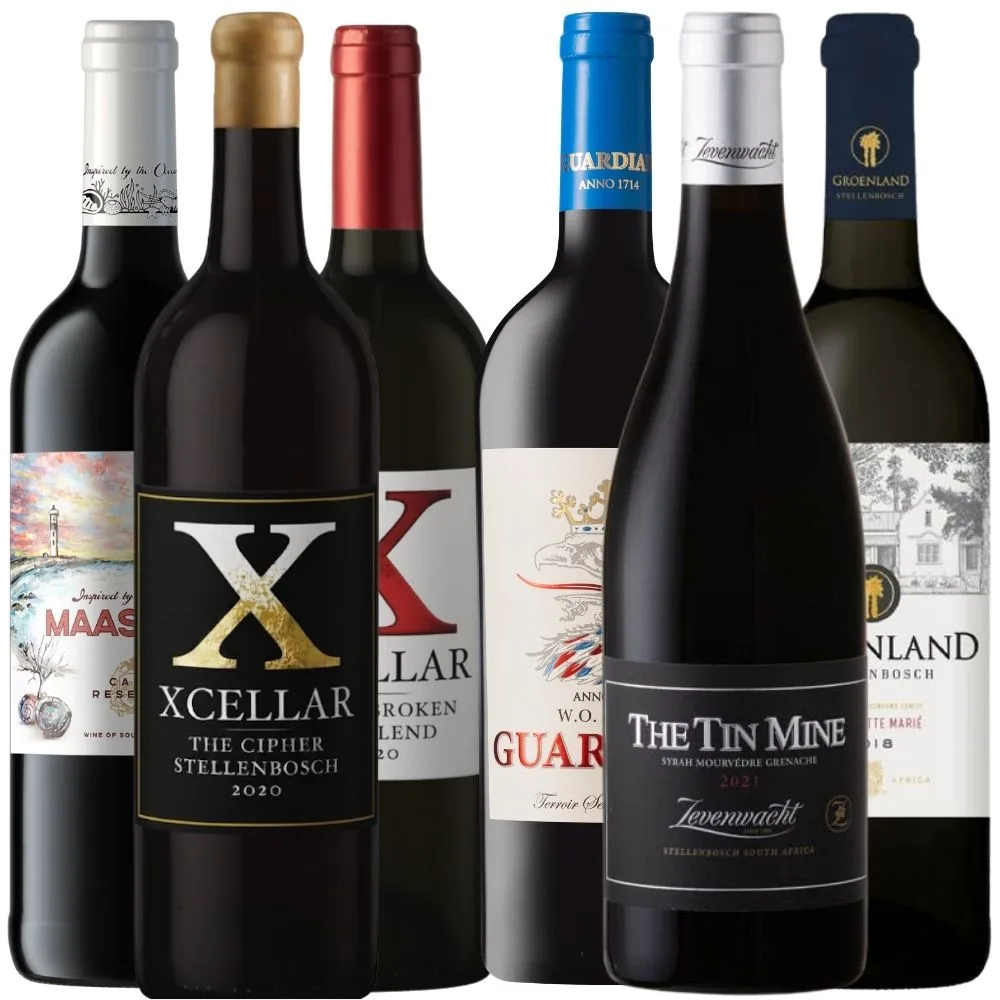
Vinty’s XCellar range is purpose-built for exactly this scenario. XCellar wines come from top Cape Winelands estates — surplus stock and limited-run parcels released without the producer’s branded label. The origin is Stellenbosch-quality. The price reflects the absence of the label premium, not the quality of what’s inside.
For someone building a cellar, this is genuinely compelling. You get estate-quality reds with the tannin structure and acidity that reward long-term ageing, at a price that makes filling a proper collection financially sensible. The XCellar Standard Range is your consistent house cellar wine. The Limited Editions are the ones to lay down.
The standout XCellar cellar candidate right now is The Cipher Stellenbosch 2020 — a Bordeaux-style blend scoring 95 points (Tim Atkin MW) and 4.5 stars from Platter’s. Cabernet Sauvignon dominant with Merlot, Petit Verdot, and Cabernet Franc, from a top Stellenbosch estate. Priced at R 1 122 per bottle — a serious wine at an unlabelled price, and exactly the kind of bottle a proper cellar was built for.
Premium Reds Worth a Dedicated Shelf
If you’re building a collection you want to open in five to ten years, these are the labelled estate bottles worth stacking:
Neil Ellis Stellenbosch Cabernet Sauvignon 2020 (R 1 422) — 4.5 Platter’s stars. Neil Ellis is one of the Cape’s great Cabernet houses, and this multi-vineyard Stellenbosch blend delivers exactly what the region does best: dense fine-grained tannins, blackcurrant and graphite, crisp acid backbone. The kind of Cab you stack in sixes and open every two years to track the evolution.
Metzer Family Cabernet Sauvignon 2022 (R 1 962) — 4.5 Platter’s stars, 92 points. Helderberg bush vine Cabernet with 10% Shiraz. Natural ferment, unfined, unfiltered. Classic cassis, dried herbs, violets and silky fine-grained tannins — the kind of wine that doesn’t happen by accident. Boutique production with serious cellaring potential and the track record to back it up.
Stettyn Jar From Dirt Syrah 2023 (R 2 382) — from one of the Breede River Valley’s most historic estates, aged in amphora and French/Hungarian oak for 18 months. Full-bodied, velvety tannins, dark berries and cracked pepper. Something genuinely different from the Stellenbosch Cab-dominant style, and exactly the kind of cellar anchor that rewards patience.
How to Think About Building a Cellar Collection
- Unlabelled wines for volume: fill the bulk of your cellar with XCellar Standard Range and rotate as you drink
- XCellar Limited Editions for laying down: The Cipher 2020 at 95 points is the obvious starting point
- Labelled estate reds for anchoring: Neil Ellis, Metzer Family, and Stettyn give you three distinct styles and ageing trajectories
- Browse all wines to round out the collection with character-driven estate bottles that complement your cellar strategy
Every bottle sold by Vinty is backed by a 100% Happiness Guarantee. If something doesn’t impress, we replace or refund it. For a cellar builder, that removes the primary risk of buying without tasting first.
Frequently Asked Questions
What is the ideal temperature for a wine cellar in South Africa?
12–14°C for long-term ageing; 14–16°C is acceptable for bottles you plan to drink within 3–5 years. Consistency matters more than hitting a perfect number — a steady 14°C outperforms a cellar that swings between 10°C and 18°C seasonally.
How do I build a wine cellar in a small space?
Under-stair storage, converted pantries, and dedicated climate-controlled cabinets all work well. The key requirements are insulation, a reliable cooling unit, and UV protection. A properly converted 2m² closet can hold 100–200 bottles and outperform a larger uncontrolled room.
What materials are best for a South African wine cellar?
Redwood racking for moisture resistance, concrete or high-R-value insulation panels for the shell, and UV-protective glass for any visible display sections. Vapour barriers are particularly important in coastal areas where humidity variation is significant.
Should I invest in a dedicated wine cooling unit?
Yes, if you’re serious about ageing. SA’s summer temperatures make passive cooling unreliable in most homes. A quality dual-zone wine cooling unit pays for itself quickly relative to the cost of spoiling a collection. Budget units start around R 3 000–R 5 000; professional cellar cooling systems run R 15 000+.
What wines are best for a South African cellar?
Structured reds from Stellenbosch, Swartland, and Paarl age best. Look for Cabernet Sauvignon, Syrah, Pinotage, and Cape Blends with firm tannins and balanced acidity. XCellar’s Limited Edition range is specifically sourced from top Cape Winelands estates and represents excellent value for cellar building.
How many bottles should a home wine cellar hold?
Start with what you’ll drink over 6–12 months, plus a laying-down allocation of bottles you plan to hold for 3–5+ years. A 48–96 bottle capacity is practical for most South African home cellars. Scale up as your collection and confidence grow.
Build the Cellar. Fill It With Wine Worth Keeping.
You now have everything you need to plan and build a proper South African wine cellar. The last step is filling it with bottles that reward the effort. Explore the XCellar range — estate-quality Cape Winelands wine at insider prices, with a 100% Happiness Guarantee. Or browse all wines to build a collection that reflects your taste.
Building a Wine Cellar in South Africa — FAQs
How much does it cost to build a wine cellar in South Africa?
A basic passive wine cellar (no active cooling) costs R15 000–R40 000 if you’re converting an existing under-stair or basement space with racking, insulation, and humidity control. A purpose-built, climate-controlled cellar runs R80 000–R250 000 depending on size and finish level. A high-end cellar with custom joinery and 1 000+ bottle capacity can exceed R500 000. Wine fridges are the entry point at R6 000–R25 000 for 100–250 bottles.
What temperature should a wine cellar be in South Africa’s climate?
12°C to 15°C is the universal target for long-term storage, with 13°C as the ideal. South Africa’s summer heat makes passive cellaring impossible in most homes without active cooling — ambient temperatures in unconditioned rooms can hit 28°C+ in Stellenbosch, Johannesburg, and Durban summers. Humidity target: 60–70%.
Do I need a wine cellar or is a wine fridge enough?
For collections under 250 bottles, a dual-zone wine fridge is the better choice — lower capital cost, lower running cost, no humidity management headaches. For collections over 500 bottles or for wines you plan to hold 10+ years, a purpose-built cellar becomes economical. The inflection point is around 300 bottles.
How many bottles fit in a small home wine cellar?
A 2 m² converted under-stair cupboard fits 250–400 bottles with efficient racking. A 4 m² walk-in cellar fits 800–1 200 bottles. A 10 m² dedicated room holds 2 500–4 000 bottles. Rule of thumb: roughly 200 bottles per square metre with wall-to-ceiling racking.
What wines are worth cellaring in South Africa?
Premium Stellenbosch Cabernet, Kanonkop Pinotage, top Swartland Syrah and Chenin Blanc, Hemel-en-Aarde Pinot Noir, and Vintage MCC. Not every wine rewards cellaring — entry-level wines under R150 are mostly built for drinking within 3 years. Look for producers that consistently make age-worthy wines (Kanonkop, Meerlust, Boekenhoutskloof, Mullineux, David & Nadia).
How long can South African wines age?
Top Stellenbosch Cabernets age 15–25 years. Premium Pinotage and Shiraz age 10–20 years. Old-vine Chenin Blanc ages 10–15 years. Vintage MCC ages 8–15 years. Everyday wines (R100–R200 range) are best within 3–5 years. South African wines age well because of consistent vintages and solid natural acidity.